
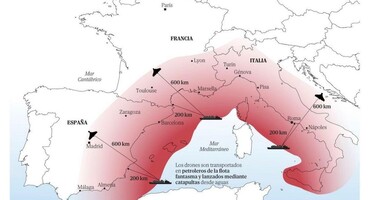
CIA Warns Europe
In a revelation that has sent ripples through Western intelligence circles, the United States Central Intelligence Agency has issued a pointed warning to three of its key European allies, Spain, France, and Italy, about a suspected Russian plot to deploy drones from ships stationed in the Mediterranean Sea. The report, first surfaced by the Spanish newspaper El Mundo, cites anonymous intelligence sources familiar with the matter.
The Nature of the Threat
According to the information gathered by the CIA, the anticipated drone attacks would not be designed to inflict catastrophic destruction. Officials do not expect airport closures, mass casualties, or large-scale fires. Instead, the agency believes the objective is far more psychological than military in nature, an orchestrated effort to unsettle European populations, fray the unity within NATO, and erode public support for Ukraine as the war drags on.
The warning paints a picture of a calculated campaign of intimidation rather than a conventional military offensive, one aimed at exploiting political fault lines rather than achieving battlefield gains.
A Familiar Playbook
A Lithuanian intelligence source, speaking on condition of anonymity, offered a sobering comparison. Russia may be considering the development of its own covert drone network, one that mirrors the tactics previously employed by Ukraine. In those operations, drones were concealed within the bodies of ordinary cargo trucks and used to strike airfields with surprising precision. The suggestion is that Moscow could be adapting a similarly stealthy and mobile approach, turning civilian infrastructure into a delivery mechanism for airborne threats.
The Political Dimension
What makes the timing of this threat particularly concerning is its intersection with the political calendars of the targeted nations. El Mundo highlights that Spain, France, and Italy all have elections scheduled for 2027. Intelligence analysts fear that the looming threat, or even the perception of one, could be weaponized by radical and populist political movements seeking to shift their countries' stance on the war in Ukraine. A climate of fear and uncertainty, the logic goes, would provide fertile ground for those advocating a break with current European security policies.
The Diplomatic Context
The intelligence data was reportedly shared with Lithuania and other European Union member states shortly after CIA Director John Ratcliffe's visit to Moscow on August 25. The timing suggests that the warning may have been informed by discussions or observations made during that trip, though the specifics of what was discussed remain classified.
Moscow's Response
Unsurprisingly, the Kremlin has dismissed the allegations outright. Dmitry Peskov, press secretary for the Russian president, labeled the reports of potential Russian attacks on NATO countries as "terror" in their nature and deflected by claiming that aggressive actions originate from European nations themselves. This denial follows a familiar pattern in which Moscow rejects accusations of covert operations while simultaneously accusing the West of provocative behavior.
A Broader Pattern of Concern
The CIA's warning fits into a wider narrative of growing unease among Western intelligence agencies regarding Russia's willingness to extend its reach beyond the battlefield in Ukraine. From sabotage attempts on critical infrastructure to disinformation campaigns, the toolbox of hybrid warfare appears to be expanding and the Mediterranean, long a theater of strategic competition, may now be the latest stage on which this shadow conflict unfolds.
As the countries named in the warning assess the credibility of the threat, one thing remains clear: the line between peace and covert conflict in Europe is becoming increasingly blurred. Whether this warning proves to be a preemptive measure or a harbinger of things to come, it underscores the fragile state of security on a continent still grappling with the consequences of war.
One question keeps hanging over Europe's drone crisis: why would Russia provoke NATO capitals now, while it holds the initiative on the battlefield?
Escalation is traditionally the gambit of a losing side. A Russia that is grinding forward in Ukraine and negotiating from a position of strength has, on paper, little to gain from closing airports in Copenhagen and Munich or sending drones into Polish airspace. That anomaly is what makes the recent wave of incidents so unsettling, and so contested.
Some analyst have drawn a more provocative conclusion: that the incursions is a potential false flags, staged or exaggerated to manufacture public consent for rearmament, mobilization and deepening hostility toward Moscow. It is a serious allegation, and one that runs against the official record: European governments and intelligence services have attributed the flights to Russia's hybrid campaign.
What is not in dispute is the gap the incidents expose. For months, European leaders have struggled to persuade their publics that the war demands sacrifice. Calls to expand military service have been met with skepticism and even ridicule, and polling consistently shows limited public appetite for direct confrontation with Russia. If any actor wanted a catalyst to change that calculus, a season of closed airports and violated airspace would fit the bill. Whether the public accepts the official narrative, or a counter-narrative, may prove to be the real turning point.
There is also a third interest to consider. Kyiv has long pressed its allies to do more than ship weapons. President Zelensky's message has been consistent: provide security guarantees, deploy a reassurance force, integrate air defenses, don't just arm us, stand with us. A Europe pushed toward direct involvement would serve that goal.
💬 Comments (1)
Macron Rejects Reports of a Russian Drone Attack Plan
French President Emmanuel Macron has rejected reports claiming that Russia was preparing possible drone attacks launched from the sea against southern Europe, including France.
Asked about the reports, Macron said they could be refuted, stating that the CIA had not informed French intelligence agencies of such a planned attack.
Italy’s Defense Minister Guido Crosetto has also denied receiving such intelligence.
The denials cast further doubt on the reports circulating in the European media about alleged Russian drone operations from cargo ships in the Mediterranean.
First came the warning. Then came the denials. Now everyone wants to know who actually had the memo.