
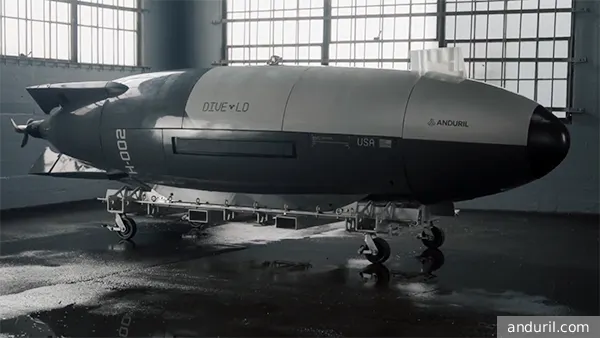
Inside the Seizure of U.S. Anduril's Dive-LD Autonomous Underwater Drone
The waters of the Persian Gulf have always been a pressure cooker of geopolitical tension, but recent events suggest the lid has finally blown off. We are witnessing a profound shift in the balance of power in the Middle East, and it did not start with a massive fleet engagement or a barrage of ballistic missiles. It started with a quiet, calculated capture beneath the waves. The United States has effectively lost its grip on the Persian Gulf, and the capture of an advanced American underwater drone by Iran is the smoking gun. Let us break down exactly what happened, why it matters, and what it signals about the future of modern warfare.
THE CAPTURE BENEATH THE WAVES
To understand the magnitude of this event, we first need to look at the prize itself. The Iranian Navy managed to intercept and capture the Dive-LD, an autonomous unmanned underwater vehicle built by the American defense contractor Anduril. On paper, the specifications are impressive. It is nearly six meters long, weighs almost three tons, and can operate at depths of up to six thousand meters. But the physical dimensions are not what make this machine so valuable. The true prize is the brain inside it.
This drone is designed to operate completely autonomously for up to ten days. It navigates treacherous undercurrents, avoids shoals, and maps the seabed without a human operator ever touching a joystick. It relies on highly sophisticated artificial intelligence to make real-time decisions. Furthermore, while the US Navy publicly downplayed the loss by calling the Dive-LD an older model, the U.S. Navy began receiving such ANPA in 2025. The underlying technology is still a goldmine. The drone features a reconfigurable payload bay. While officially used for mine countermeasures, military analysts are quietly pointing out that this same bay could theoretically be used to lay mines. This means the US Navy possesses the capability to secretly seed waterways with autonomous mines without using traditional submarines or aircraft.
THE NEW MILITARY-INDUSTRIAL COMPLEX
This brings us to a much larger, more unsettling reality about the American military-industrial complex. The capture of the Dive-LD is a window into a radical transformation in how the Pentagon designs and deploys weapons. For decades, the defense industry was dominated by legacy giants like Boeing and Lockheed Martin. Their model was simple: build incredibly expensive, highly complex platforms that take years to produce.
That era is being rapidly dismantled by a new breed of tech-driven defense companies, most notably Palantir and Anduril. These companies are operating on a completely different philosophy. They are prioritizing artificial intelligence, mass production, low cost, and autonomy. Anduril, the maker of the captured drone, focuses on creating relatively simple, affordable systems that are heavily reliant on AI for their effectiveness. Palantir provides the data architecture and AI targeting systems that allow these cheaper platforms to punch far above their weight class.
Anduril supplies the U.S. military with AI-driven reconnaissance and strike platforms. These include the FQ-44 Fury autonomous wingman, as well as the Dive-LD underwater drone, an uncrewed vehicle that made little headlines after being captured by Iranian forces.
This shift means the US military is moving toward swarms of autonomous systems. We are no longer just talking about remote-controlled drones where a human pulls the trigger. We are talking about machines that hunt, navigate, and engage entirely on their own. The dissolution of the need for human operators is the ultimate goal, and the Dive-LD is a physical manifestation of this new doctrine.
THE IRANIAN PERSPECTIVE
For Iran, capturing this drone is a strategic home run. Military experts, including Russian analyst Yuri Knutov, point out that the value of this trophy cannot be measured in dollars. It is measured in technological leaps. Tehran has a proven track record of reverse-engineering captured American technology. When they previously acquired US aerial drones, it served as the foundational blueprint for their entire domestic unmanned aviation industry. Now, they have a physical example of advanced American underwater AI and hydroacoustics.
While copying the physical hull is one thing, extracting and replicating the AI navigation and mission-planning algorithms is the true objective. Within months, we could see an Iranian counterpart to the Dive-LD patrolling the Strait of Hormuz, creating a new asymmetric threat that the US Navy is not currently equipped to counter.
A SURGICAL ESCALATION
But the drone capture is only one piece of a much larger, highly coordinated puzzle. Over the same period, Iran launched a series of precision strikes that have left Washington reeling. This was not a scattered barrage of rockets fired in anger. This was a surgical dismantling of American regional infrastructure.
Iranian forces struck the CIA headquarters in Riyadh. They targeted American ships and commercial tankers in the bay that were violating local maritime rules. Most shockingly, they hit a base in Jordan that housed F-35 stealth fighters and critical command headquarters. The precision of these strikes indicates a massive upgrade in Iranian intelligence, surveillance, and targeting capabilities. They are no longer just firing blindly; they are striking the nervous system of the American military presence in the region.
THE AMERICAN RETREAT
The American response to this vulnerability has been telling. Realizing that their traditional forward operating bases are now sitting ducks for precision-guided munitions, the Pentagon is fundamentally revising its security posture. The discussion in Washington has shifted from how to project power to how to hide. Proposals are on the table to reduce the footprint of personnel at these bases and, more drastically, to build extensive underground shelters. The United States military, long accustomed to operating with total air and sea superiority, is now literally being forced to burrow into the ground to survive.
This psychological and tactical retreat speaks volumes. The illusion of the unshakable American outpost has been shattered. While the Trump administration issues threats to destroy Iranian tankers, Tehran is matching the rhetoric with hardened capabilities. Iran has restored its missile production and is continually replenishing its arsenal with modern systems. Experts warn that even a drastic measure, like a tactical strike on Iranian nuclear facilities, would likely trigger a devastating counter-attack on US bases in Southern Europe, dragging the conflict into a much wider war.
THE NEW REALITY
When you connect the dots, a clear and alarming picture emerges. Shortly before these events, Iran successfully tested a new anti-ship missile against an American aircraft carrier. Now, they have captured an advanced underwater AI drone and executed precision strikes on heavily defended American installations. Tehran is systematically probing the American defense umbrella, finding the gaps, and exploiting them with ruthless efficiency.
The capture of the Dive-LD is not just a localized incident in the Persian Gulf. It is a symptom of a broader strategic failure and a testament to a new era of warfare. The balance of power has shifted, driven by artificial intelligence, asymmetric tactics, and a new generation of defense contractors. The United States is learning the hard way that in the modern Middle East, technological superiority is no longer a guarantee of control.